

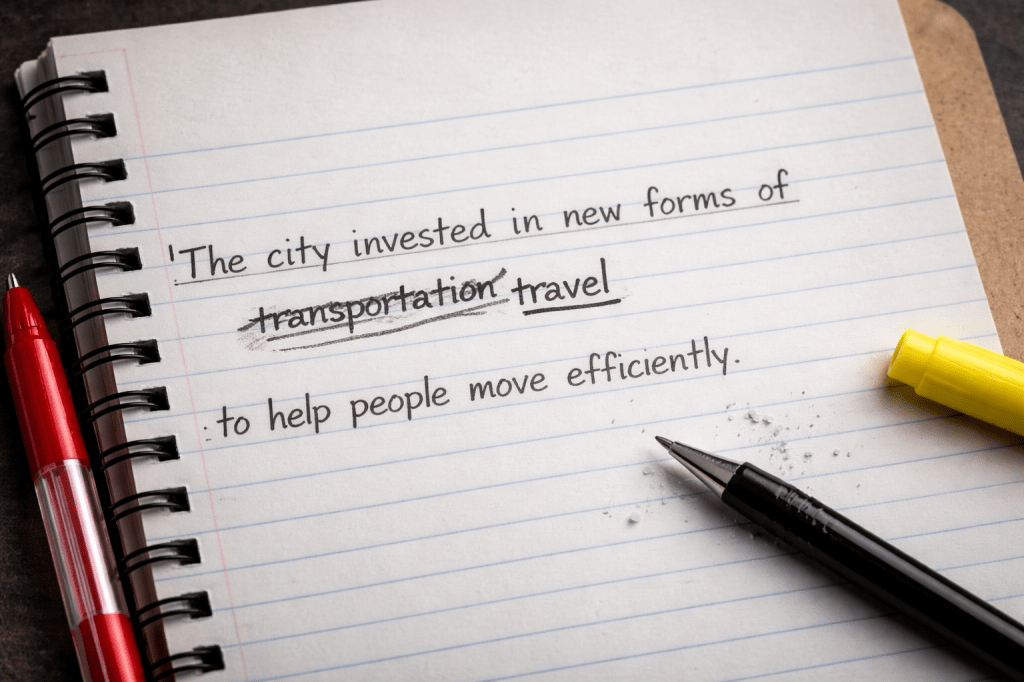
That moment a student says “travel” for “transportation” isn’t careless. It’s a window into something much more interesting.
An essay on compensatory reading strategies in adolescence
Picture a sixth grader—confident, on task, reading aloud from a science textbook. The passage is about urban infrastructure. She moves through the sentences at a reasonable clip, voice steady. Then she hits a long word: transportation. There’s a half-second pause, almost imperceptible. Then:
The Moment
“The city’s travel systems were overwhelmed by the growing population.”
Travel. Not transportation. She moved on without breaking stride. The sentence still worked. The meaning held, at least mostly. And nobody in the room, including her, flagged it as a mistake.
On the surface, it sounds close enough. The sentence kind of works. But that moment reveals something much deeper than a simple slip of the tongue. It reveals a reading brain that has learned to do something remarkably sophisticated: survive without fully decoding every word.
This is Not Random Guessing
The first and most important thing to understand is that what just happened was not an accident. It wasn’t a lapse in attention. It wasn’t laziness. It was the product of years of accumulated strategy, refined if largely invisible.
By the time students reach middle school, the ones who struggle with decoding haven’t simply failed to pick up a skill. They’ve built elaborate workarounds. They read context clues. They track sentence syntax. They draw on prior knowledge. They predict—constantly and automatically—what a word probably is based on everything around it.
These readers aren’t guessing blindly. They’re predicting strategically.
The distinction matters enormously. Random guessing looks erratic. Strategic prediction looks fluent. And that’s exactly what makes it so easy to miss, and so persistent.
What’s Happening Inside the Brain
To understand why, it helps to understand what skilled reading actually requires. At its core, proficient reading depends on two things working together: automatic word recognition and language comprehension. When both systems run smoothly, reading feels effortless. Words are recognized instantly; meaning is built in real time.
But when decoding isn’t automatic—when a reader can’t identify words at a glance—the brain doesn’t shut down. It adapts. Cognitive resources that would otherwise go toward word recognition get redistributed. The brain leans harder on context: the surrounding words, the grammatical structure of the sentence, what the reader already knows about the topic.
This is a genuinely impressive feat of neural reallocation. The brain, faced with an inefficient process, finds another route to the same destination. And in adolescence, after years of practice, this rerouting has become second nature. These students are often extraordinarily good at masking the places where their decoding breaks down.
The brain is prioritizing meaning over accuracy because it has to.
Why the Strategy Develops—and Why It Sticks
No student consciously decided to start substituting words. The strategy emerged gradually, over years, because it worked. “I can get by without fully reading every word” is not a thought anyone has explicitly—it’s a lesson the brain learns through repetition.
And the environment often reinforces it. Comprehension questions can be answered with a general grasp of the passage. Many texts, especially at younger grade levels, are predictable enough that a skilled predictor can navigate them with minimal decoding. Avoiding visible struggle—in a classroom, in front of peers—becomes its own reward.
When a strategy reduces effort, avoids failure, and produces acceptable results, it doesn’t fade. It calcifies.
The strategy works just well enough to survive. And that’s what makes it stick.
Why Adolescence Is When It Becomes a Problem
Here’s where the story shifts. The same brain that navigated elementary school with this workaround starts running into serious friction around sixth or seventh grade—not because the student has changed, but because the texts have.
Middle and high school reading demands something different. Passages are denser. Vocabulary is technical, precise, and domain-specific. Predictability drops sharply. A student who has coasted on context clues now encounters sentences where every word carries load-bearing weight.
The words transportation and travel are not the same thing in a geography lesson. Similarly, analyze and look at are not the same thing on an essay prompt. Photosynthesis cannot be approximated. These are words where approximation fails—where the predicted word and the actual word carry meaningfully different information.
The consequences accumulate quietly. Misunderstandings compound. Reading becomes effortful in a way the student may not be able to articulate—just a persistent sense of exhaustion, of never quite landing on solid ground. Confidence erodes, usually below the surface, often hidden behind perfectly acceptable grades on multiple-choice assessments.
What This Reveals About Learning—Broadly
Step back from reading for a moment. What this pattern reflects is something fundamental about human cognition: when a skill is costly, the brain finds a cheaper path to a similar outcome. We don’t stop. We adapt. We approximate.
Adolescents are particularly skilled at this kind of efficiency-seeking. Social stakes are high; looking capable matters deeply. The brain becomes expert at producing outputs that signal competence while minimizing the exposure of genuine difficulty. This is not a character flaw—it is a cognitively sophisticated response to a challenging environment.
The principle underneath it is simple and important:
When accuracy is costly, the brain defaults to approximation.
What Actually Changes the Pattern
Understanding the behavior points toward what can shift it—and equally, what won’t. This isn’t about motivation. Students who predict strategically are often highly motivated readers; they’ve been working hard for years to compensate. The issue isn’t effort. It’s the absence of automaticity at the level of individual word recognition.
What the brain needs isn’t more encouragement to try harder. It needs the underlying bottleneck addressed: the ability to recognize words accurately, quickly, and without effort. That means precise, repeated, successful decoding practice—the kind that gradually reduces the cognitive cost of word recognition until compensation is no longer necessary.
When reading a word no longer requires significant mental energy, the brain doesn’t have to borrow from context to fill the gap. It simply reads.
When the brain no longer has to compensate, it stops guessing.
Back to the Moment
A seventh grader. A science textbook. The word transportation. A half-second pause. Then: “travel.”
She wasn’t careless. She wasn’t checked out. She wasn’t even wrong in her intention—she was trying to get the meaning, and she mostly did. What that moment revealed wasn’t a character problem or an effort problem. It revealed a brain doing exactly what brains do: finding the most efficient path available with the tools at hand.
The guess is not the problem. It’s the signal. It’s the evidence that somewhere underneath the fluency, a foundational process hasn’t yet been made automatic—and that the brain has quietly, efficiently, invisibly built a life around that fact.
The Takeaway
“Transportation.” “Travel?”
Not careless. Not lazy. Not even wrong in intention.Guessing isn’t the problem. It’s the evidence.
 Teen Foundations: Foundational Skills for Older Students
Leave a comment