

As a reading interventionist for upper elementary and middle school age students, most of my job includes working with students who are behind their peers in reading. They may struggle with decoding, fluency, or comprehension, and their confidence in their reading abilities is often low. This also means that reading tends to be waaaay down on their list of preferred activities. The question I have been working to answer since I started this job is: what’s the most effective approach to help these students catch up? Two prominent approaches are often debated: structured literacy and balanced literacy. Let’s take a closer look at each and see how they might apply to our older learners.
Balanced Literacy: A More Holistic Approach
Balanced literacy is a more holistic approach that aims to create a love of reading while also teaching reading skills. It typically involves a mix of whole-class instruction, small-group guided reading, and independent reading. Balanced literacy classrooms often have rich libraries of diverse texts, and teachers use a variety of strategies to engage students in reading and writing.
Part of balanced literacy includes an outdated method called 3-cueing (or MSV). Cueing has been shown to actually hinder reading development rather than help it. This method encourages students to guess at words based on context, picture clues, and the first letter sound, rather than systematically decoding the word. This leads to a reliance on guessing and often results in misreading words and misunderstanding the text.
While balanced literacy can be effective for some students, it’s probably not be the best approach for older struggling readers who have significant gaps in foundational skills. The emphasis on independent reading and self-discovery can be overwhelming for these students, who need more explicit and structured instruction to catch up.
Structured Literacy: A Systematic and Explicit Approach
Structured literacy is a research-based approach that emphasizes explicit, systematic instruction in all five components of reading: phonemic awareness, phonics, fluency, vocabulary, and comprehension. Instruction is carefully sequenced and builds upon previously learned skills, ensuring that students have a strong foundation before moving on to more complex concepts.
For older struggling readers, structured literacy can be a game-changer. By revisiting foundational skills like phonics and decoding, students can fill in gaps in their knowledge and develop the tools they need to tackle multisyllabic words and complex texts. This approach also emphasizes the importance of teaching morphology (the study of word parts), which can help students decode and understand unfamiliar words.
Research suggests that structured literacy is particularly effective for students with dyslexia or other reading difficulties (Sesma et al., 2000; Mahone et al., 2010). However, it can benefit all learners, providing a clear and systematic path to reading success.


Finding the Right Balance for Older Students
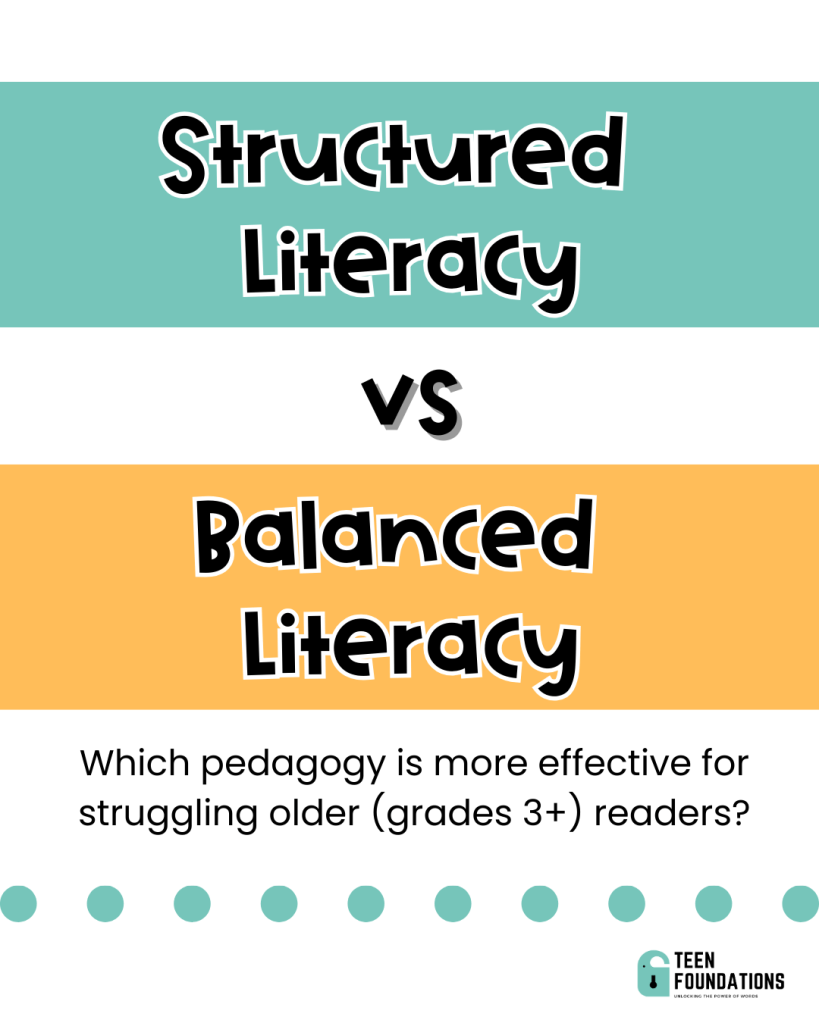
In my experience, an approach to reading intervention that emphasizes explicit instruction is the most effective for older struggling readers. Here’s how it might look:
- Targeted Intervention: Begin with targeted intervention focused on filling in gaps in foundational skills, using a structured literacy approach. This might involve explicit instruction in phonics, decoding, and morphology.
- Small Group Instruction: Provide small-group instruction to address specific needs and provide more personalized support.
- Gradual Release of Responsibility: As students gain confidence and skills, gradually transition to more independent reading activities, using balanced literacy strategies like guided reading and independent reading.
- High-Interest Texts: Choose engaging and relevant texts that appeal to older students’ interests. This can help motivate them to read and practice their skills.
- Choice and Autonomy: Give students some choice and autonomy in their reading selections and activities. This can foster a love of reading and make the learning process more enjoyable.
Ultimately, the best approach will depend on the individual needs of each student. However, for older students who struggle with foundational reading skills, a structured literacy approach, combined with some of the elements of balanced literacy, can provide the support they need to catch up and become confident readers.
If you’re looking for resources to support your reading intervention efforts, check out my TPT store, Teen Foundations. I offer a variety of engaging and effective materials designed specifically for middle school students, including phonics and decoding resources, fluency practice materials, vocabulary builders, and comprehension activities.
It’s never too late to become a successful reader! With the right support and instruction, older struggling readers can thrive.
 Teen Foundations: Foundational Skills for Older Students
Leave a comment