
Well, it’s back to school time once again. Ready or not, here they [the kids, that is] come! Honestly, as much as I’ll miss the lazy days… and crazy busy days… of summer, I can’t wait to get back to my school kiddos.
As a Title 1 Reading teacher, I am passionate about equipping students with the foundational reading skills they need to succeed in their academic journey. This school year, I want to secure these skills for my students. I teach upper elementary grades, specifically 5th and 6th graders, many of whom still struggle with foundational reading skills. By focusing on these skills, I hope to lay a solid groundwork for my students’ future academic success and empower them in all areas of learning.
Early Learners vs. Older Students… It’s Not Apples to Apples
Working on foundational reading skills with older students presents some unique challenges. Unlike younger students, older students may have already developed some reading skills, but they may still struggle in specific areas or even with some specific, isolated skills. By 5th and 6th grade, most kids have developed basic reading skills; however, some may still struggle with fluency, decoding, and comprehension. By addressing these areas, we provide them with the tools to become confident readers. With confidence, students are more likely to engage with texts, actively participate in class, and take on more challenging reading materials. These students often require more targeted interventions to address their individual needs and fill any gaps in their reading abilities.
Most older students have a greater cognitive capacity, enabling them to engage in more complex discussions about literacy and reading strategies. They can also take ownership of their learning, setting goals, and actively participating in their own skill development. By tailoring instruction to their specific needs and encouraging their active involvement, we can help older students strengthen their foundational reading skills and lay a solid groundwork for their continued academic success.
| Teaching Early Readers | Teaching Older Students | |
|---|---|---|
| Developmental Stage | Focus on pre-reading skills such as phonemic awareness and letter recognition | Building upon existing reading skills and addressing specific areas of weakness |
| Instructional Approach | Emphasis on explicit and systematic phonics instruction | Targeted interventions tailored to individual needs |
| Reading Materials | Simple, decodable texts with repetitive patterns and high picture support | More complex texts with a wider range of vocabulary and content |
| Engagement Strategies | Interactive activities, games, and multisensory techniques | Discussions, critical thinking activities, and independent reading |
| Motivational Factors | Utilize rewards, praise, and positive reinforcement to foster a love for reading | Encourage ownership of learning, setting goals, and exploring personal interests |
| Social Interaction | Collaborative learning experiences, peer modeling, and shared reading | Opportunities for group discussions and cooperative learning |
| Cognitive Abilities | Focus on basic literacy skills and foundational knowledge | Engage in higher-order thinking, analysis, and application of reading strategies |
| Technology Integration | Utilize interactive apps, digital resources, and educational websites for reinforcement | Incorporate digital tools for research, online discussions, and accessing a variety of texts |
| Individualized Instruction | Differentiated instruction to meet diverse needs | Personalized interventions based on specific challenges and strengths |
| Metacognitive Skills | Limited focus on self-monitoring and metacognitive strategies | Encourage self-reflection, monitoring comprehension, and applying effective reading strategies |
Securing foundational reading skills in 5th and 6th graders can help nurture a love for reading that can last a lifetime. When students are proficient readers, they become more drawn to the diverse range of literature available to them. Cultivating a love for reading creates a ripple effect, fostering a passion for learning and exploration that extends beyond the confines of the classroom.
Equity in education is a top priority in today’s educational landscape. By equipping our students with robust foundational reading skills, we bridge the achievement gap, ensuring that every child, irrespective of their background, has an equal opportunity to succeed academically. These skills lay the foundation for a brighter future, unlocking doors to endless possibilities.
Comprehension, Vocabulary, and Fluency, Oh My!
A strong emphasis on foundational reading skills strengthens a student’s ability to comprehend texts. Fluency, phonics, and word recognition skills all contribute to understanding the meaning behind the words on the page. Improved comprehension unlocks the door to higher-level thinking, critical analysis, and deeper connections with the text. These skills are essential for success in all academic subjects, from science to social studies to literature.
As students move into the upper elementary grades, the complexity of reading texts increases. Developing foundational reading skills helps students become independent word learners, allowing them to expand their vocabulary exponentially. A robust vocabulary not only aids in understanding more advanced texts, but it also improves written and oral communication skills, fostering greater self-expression and articulation.
As we embark on this new school year, join me in remembering the empowering impact of securing foundational reading skills for our older students. By doing so, we can equip our students with the tools they need to flourish academically and beyond.
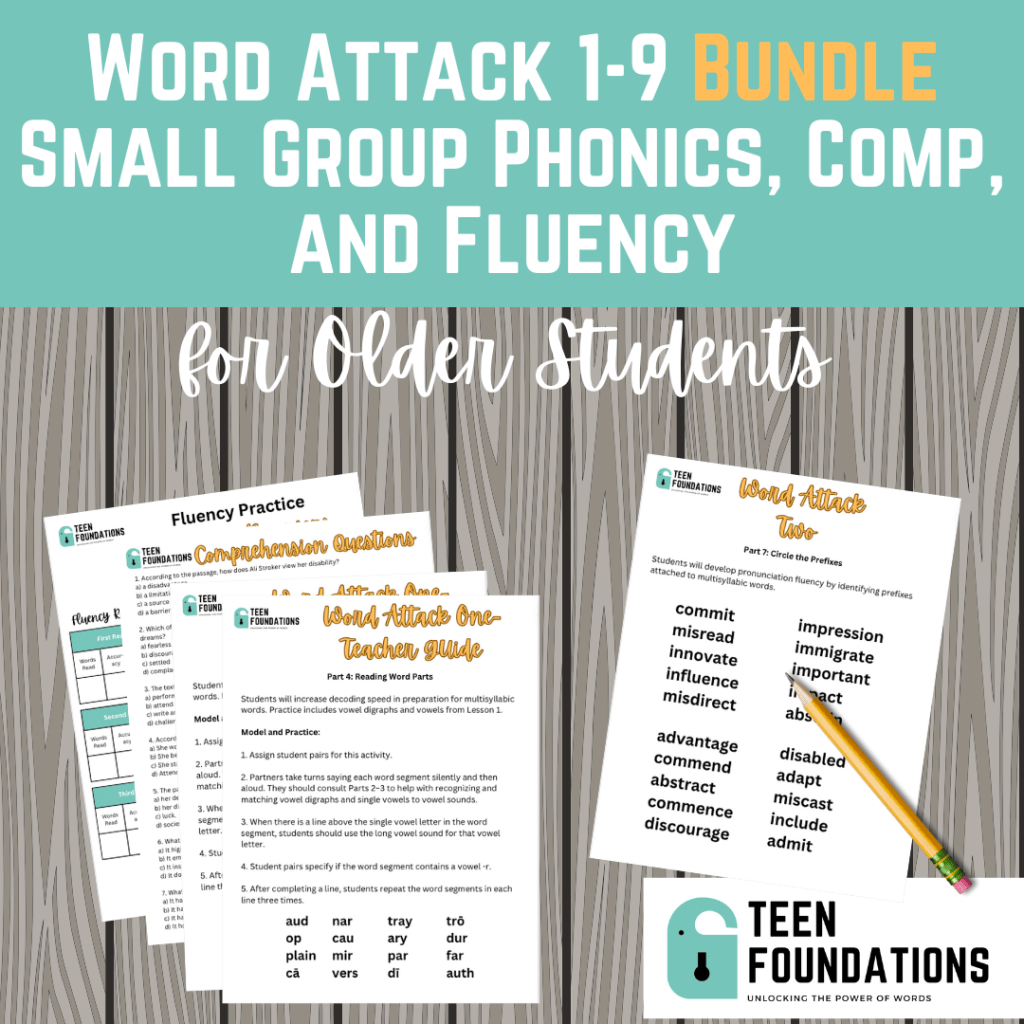
If you’re just joining the reading foundations journey with older students, consider using Word Attack, a systematic approach for small groups.
 Teen Foundations: Foundational Skills for Older Students
Leave a comment