
Sound walls are visual aids that can be used to help students learn about the sounds of the English language. They are often used in classrooms with young children, but they can also be helpful for older students who are struggling with foundational reading skills.

Why use a sound wall?
Research in the science of reading tells us that sound walls are a much more effective tools than the traditional word walls. There are a few reasons why sound walls can be helpful for older students with reading difficulties. First, they can help students to visualize the sounds of the English language. This can be especially helpful for students who are struggling to hear the differences between sounds. Sound walls also help students to learn the relationship between sounds and letters. This is important for students still learning to decode words.
Sound walls can provide a visual reference for students when they are reading. The use of pictures of mouth shapes on sound walls are a simple and effective way to help older students who are struggling with foundational reading skills. The pictures students visualize the way that sounds are produced in the mouth. This is especially helpful for students who are struggling to hear the differences between sounds or who are not sure how to produce certain sounds correctly. A study by Moats (2010) found that students who were taught to associate sounds with pictures of mouth shapes were more likely to be successful readers than students who were not taught this association.
Freebie Alert!
Check out my FREE Cheetah Print Vowel Valley in four colorways!

How to Use a Sound Wall
There are a few different ways to use a sound wall. One way is to use it as a reference tool. Students can refer to the sound wall when they are reading or writing to help them remember the sounds of letters or the order of sounds in words.
Another way to use a sound wall is to use it as a learning tool. Students can use the sound wall to practice identifying sounds, blending sounds together, and segmenting words into their individual sounds.
Tips for Older Students
When using a sound wall with older students, it is important to keep a few things in mind. First, it is important to make sure that the sound wall is visually appealing to older students. This means using bright colors and clear labels. I’ve designed different sound walls for my students to use that don’t look “babyish.” Big kids who need work with their foundational skills are still big kids… they don’t want to use materials that look like they’re made for Kindergarteners.
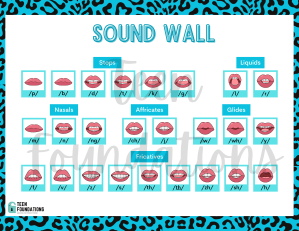
It’s also important to use the sound wall in a variety of ways. Students should not only use the sound wall as a reference tool. You can plan lessons that use it as a learning tool as well. Consider some of the following ways to use a sound wall as a learning tool:
- Identifying sounds: Students can use the sound wall to identify the sounds that make up words.
- Blending sounds: Students can use the sound wall to blend sounds together to form words.
- Segmenting words: Students can use the sound wall to segment words into their individual sounds.
- Learning about the relationship between sounds and letters: Students can use the sound wall to learn about the different ways that sounds can be represented by letters.
- Practicing decoding: Students can use the sound wall to practice decoding words.
- Learning about different dialects: Students can use the sound wall to learn about different dialects and how they affect the pronunciation of words.
If you’re a teacher or parent of an older student who struggles with reading, you may want to consider using a sound wall. When used effectively, sound walls can help students to improve their reading skills. With regular use, a sound wall can help your student to improve their reading skills.
Check out my bundles of phonics posters for secondary and older students!
 Teen Foundations: Foundational Skills for Older Students
Leave a comment