
Phonemic awareness is the ability to identify and manipulate individual sounds, or phonemes. Phonemes are the smallest units of sound in spoken language. Phonemic awareness is a critical skill for reading success, as it is the foundation for phonics and decoding. Without It, children will struggle to learn how to read and write. Phonemic awareness is a subset of phonological awareness.
Phonological awareness is the ability to hear and manipulate the sounds of spoken language. It includes skills such as identifying individual sounds in words, blending sounds together to form words, and segmenting words into their individual sounds. Before diving into the world of reading and spelling, children must first develop their phonological awareness skills. This involves honing their ability to identify rhyming words, decipher alliteration, and count syllables within a word. According to Hulme, et. al (2012), phonological awareness is the most common source of reading difficulties at the word level. As teachers, understanding the importance of phonological awareness and nurturing these skills in your students can greatly impact their future literacy success.
Why is it important for older students to develop phonemic awareness?
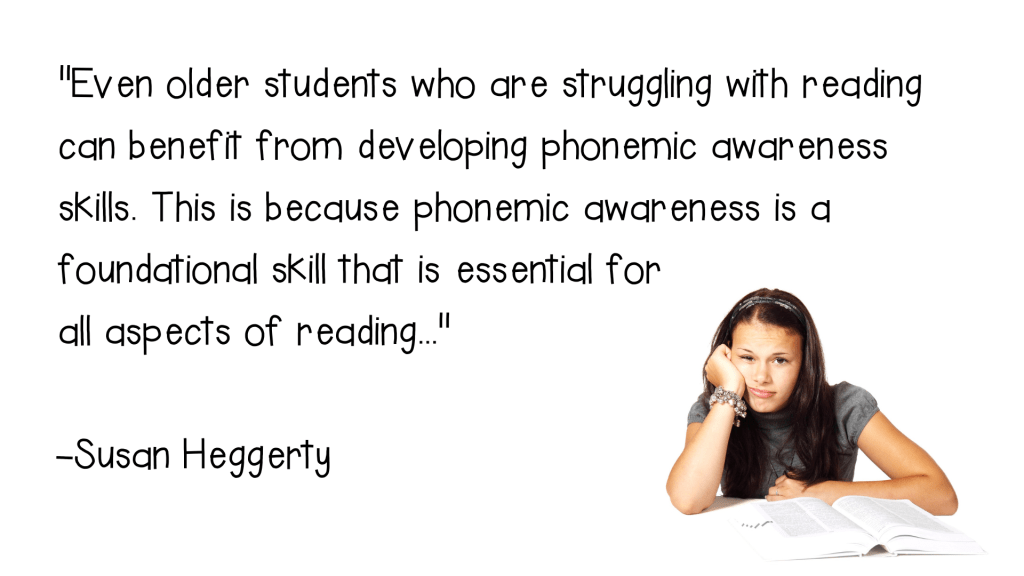
Even older students who are struggling with reading can benefit from developing phonemic awareness skills. This is because phonemic awareness is a foundational skill that is essential for all aspects of reading, including decoding, fluency, and comprehension.
Phonemic awareness is essential for both decoding (reading) and encoding (writing). Both of these processes require the ability to identify and manipulate the individual sounds in spoken words.
How can older students develop phonemic awareness?
There are many different ways to help older students develop phonemic awareness. Some effective methods include:
- Direct instruction: This involves explicitly teaching the skills to students. This can be done through whole-group instruction, small-group instruction, or individual tutoring. This is the method I use most in my Title 1 Reading Intervention groups.
- Games and activities: There are many fun and engaging games and activities that can be used to teach phonemic awareness skills. These activities can help students practice the skills in a fun and motivating way.
- Reading aloud: Reading aloud to students is a great way to expose them to new words and sounds. It also helps them develop their listening comprehension skills, which is essential for phonemic awareness.
Instructional Choices for Older Students
One resource that can be helpful for older students who are struggling with phonemic awareness is the book Bridge the Gap Phonemic Awareness Intervention by Heggerty. This book provides a comprehensive overview of phonemic awareness and how to teach it to older students. Its curriculum structure moves from phoneme isolation to blending and segmenting then to phoneme manipulation. It also includes an assessment that shows where students struggle. I use that assessment to help plan instruction.
Another resource that can be helpful for older students who are struggling with phonemic awareness is the Kilpatrick One-Minute Drills from the book Equipped for Reading Success. These drills are short, engaging activities that can be used to practice phonemic awareness skills. In my school we administer PAST (Phonological Awareness Screening Test) as a universal screener. One-minute drills are then used as a school-wide intervention beginning at the level where most students show missing skills. Because they’re one-minute, it’s a quick and easy way to get a lot of bang for our buck (aka $= ⏱).
Guess what? Kids– even big kids– LOVE to do phonemic awareness exercises! I usually do them at the beginning of each intervention lesson, and they are SURE to let me know if I forget! They’re kind of like brain teasers.
What’s different for older students?
There is research that suggests that older students need to encode (write) during phonemic awareness practice instead of just doing it orally.
One study, conducted by Hatcher et al. (1994), found that children who were taught to manipulate phoneme-grapheme relationships during phonemic awareness instruction were more likely to be successful readers than children who were not taught these relationships. The researchers argued that learning how to manipulate phoneme-grapheme relationships during phonemic awareness instruction is the key to ameliorating early reading failure.
Another study, conducted by Weiser and Mathes (2011), found that older students who were taught to encode during phonemic awareness practice made significantly more progress in reading and spelling than students who were not taught to encode. The researchers concluded that encoding instruction is essential for older students who are struggling with reading and spelling.
What can you do?
If you are concerned that your older students may be struggling with phonemic awareness, there are a few things you can do. First, give an assessment like the PAST. This can take a bit of time (the first time you give it, expect at least 10 minutes per student) but it’s worth it to discover the source of missing skills for your struggling readers. Once you’ve learned where the missing skills lie, choose a resource, like Bridge the Gap or One-Minute Drills, to begin to provide intervention. Don’t forget to progress monitor after intervals so you know whether your interventions are working! Incorporating these strategies and interventions can make a significant difference in improving phonemic awareness for older students. Happy teaching!
 Teen Foundations: Foundational Skills for Older Students
Leave a comment